

What is Rutherglen Muscat? Australia’s Liquid Gold Explained
If you’ve ever had the pleasure of visiting Rutherglen, you’ll know that this little corner of North East Victoria is the Muscat capital of the world. We don’t like to brag. Okay, fine, we do. But when your region produces the most awarded, most imitated and least replicable fortified wine on the planet, a little pride is warranted.
Muscat of Rutherglen offers a depth of flavour, texture and complexity like no other wine style. It is at once intensely rich and surprisingly refreshing, deeply historical and entirely alive. At Stanton & Killeen, we have been making it for seven generations, and we still find something new to appreciate in every glass.
So, what exactly is Rutherglen Muscat, how is it made, and which one should you choose? This is the complete guide.
What is Rutherglen Muscat?
Rutherglen Muscat is a fortified wine, meaning its fermentation is arrested partway through by the addition of neutral grape spirit. This locks in natural sweetness, lifts the alcohol to around 18 percent, and creates the foundation for one of the world’s most complex styles of wine.
The result is rich, viscous and deeply aromatic: raisins, toffee, dark chocolate, orange peel, roasted nuts and a finish that seems to go on forever. But what makes it genuinely unique is not just the flavour. It is the place. Muscat of Rutherglen can only be called that if it is grown and produced in Rutherglen. The wines carry a protected trademark, a mark of authenticity that cannot be applied to anything made outside the region. There is no equivalent anywhere else in the world.
Rutherglen Muscat is not just Australia’s greatest fortified wine. Many would argue it is Australia’s greatest wine, full stop.
The Grape: Brown Muscat
There are more than 200 varieties in the Muscat family grown globally, but Rutherglen uses only one: Muscat à Petits Grains Rouge, known locally as Rutherglen Brown Muscat. The name refers to the reddish-brown colour of the berries at full ripeness: small, intensely flavoured and bursting with natural sugar.
The small berry size is not incidental. More skin relative to juice means more colour, more flavour and more of everything that makes Rutherglen Muscat what it is. The Muscat clones used here are specific to Rutherglen and have been grown in the region for more than 140 years. You could not transplant them elsewhere and expect the same result. They are shaped by this place, and this place alone.
Why Rutherglen? What Makes This Region So Special for Muscat
Rutherglen Muscat cannot be replicated anywhere else in the world. That is not marketing language. It is a statement of fact, and it comes down to a combination of factors that exist nowhere else in quite the same way.
The Climate
Rutherglen sits at 130 to 180 metres altitude in Victoria’s High Country, nestled between the Great Dividing Range and the Murray River. It has a classic continental climate: wet winters and springs that allow the vineyards to retain excellent moisture well into the growing period, long hot summer days followed by cool dry nights, and most critically, a long, warm and usually dry autumn.
That autumn is everything. It gives Muscat grapes up to two extra weeks of ripening on the vine, allowing sugars and flavours to concentrate naturally without the mat-drying methods used in other sweet, fortified styles around the world. The cool air drifting down from the mountains overnight prevents disease, mould and mildew during this vulnerable period. The result is grapes of extraordinary intensity, grown the way nature intended.
The Soil
Soils vary across Rutherglen. At Stanton & Killeen, the predominant soil is red loam over clay, known locally as Rutherglen Loam. Rich in minerals and with excellent moisture-holding ability, it is particularly well suited to the warm, dry growing conditions of the region. Other areas of Rutherglen feature fine sandy loam along old river banks, which produces more perfumed and delicate wines, and shale and quartz bands, a more challenging profile that pushes vines to produce intensely flavoured fruit. Each soil type leaves its mark on the wine.
Vine Age
Most Muscat vines in Rutherglen are between 30 and 50 years old, and with age comes depth. Old vines push their roots deep, draw from a broader range of minerals and produce smaller yields of far more concentrated fruit. At Stanton & Killeen, our Jack’s Block Muscat vineyard is 105 years old and still producing some of the highest-quality fruit on the property. Those vines have seen a century of Rutherglen summers. That experience shows in the glass.
How Rutherglen Muscat is Made
Harvesting
Muscat is one of the last varieties harvested at the end of each vintage, typically in April and May. It is not a process for the impatient. The grapes must be left on the vine as long as possible to concentrate their sugar and flavour, but this extended hangtime carries risk: early autumn rain or botrytis can ruin a crop in days.
In good years, sugar levels in the grapes may reach more than 20 Baumé, a measurement of dissolved solids that indicates sugar concentration and potential alcohol. Most vintages are harvested at 17 or 18 Baumé. For context, a dry table wine is typically picked at 12 to 13 Baumé. The grapes are, in short, extraordinarily ripe. Many berries have begun to shrivel and raisin on the vine before they are even picked. Extracting the syrupy juice from this raisined fruit is an incredibly sticky task that demands patience at every step.
Fermentation and Fortification
After harvesting, the Muscat is fermented on skins for a short period, creating just 1 to 2 percent alcohol before the addition of fortifying spirit stops fermentation after pressing. That spirit, a pure grape spirit, raises the alcohol to around 18 percent while preserving the natural sweetness of the fruit.
This is fundamentally different to making dry table wine, where fermentation runs until all sugar converts to alcohol. With Muscat, we deliberately stop that process early. We want the sugar. We want the fruit. The spirit is the tool that locks it in.
The Barrels
Following fermentation, the new Muscat is transferred to mature oak casks of various sizes for aging. Many of Stanton & Killeen’s Muscat casks are more than 100 years old. Mature oak is deliberately chosen because it allows the flavours of the fruit to integrate and develop without imparting strong oak character. These casks are vessels for patience, not flavour donors. It is the fruit, not the wood, that defines Rutherglen Muscat.
Cask size matters too. The smaller the cask, the quicker the concentration and development of the wine. Sizes at Stanton & Killeen range from 60 litres to 5,000 litres, and the winemaker’s blending program determines which casks are used for which material.
The placement of casks within the winery also plays a role. Barrels stored in warmer parts of the shed mature faster than those in cooler areas. Wine development accelerates over summer and slows through winter, driven by the dramatic temperature swings inside the tin-roofed sheds that are a hallmark of Rutherglen winemaking.
The Angels’ Share
Evaporation plays an integral part in the maturation of Rutherglen Muscat. On average, the maturing casks lose 3 to 5 percent of their volume each year to what winemakers call the angels’ share. Over 20 years, the angels take half of every barrel. That loss concentrates everything that remains: flavour, complexity, colour and texture.
It also makes the production of aged Rutherglen Muscat a genuinely costly enterprise. But without that slow, patient evaporation, the wine could never reach the extraordinary richness of a Grand or Rare. The angels earn their share.
The Blending
Contrary to popular belief, age alone does not determine the complexity of Rutherglen Muscat. At Stanton & Killeen, we create our final Muscat blends using a modified solera system, a blending and ageing process that ensures consistency of style across years and decades.
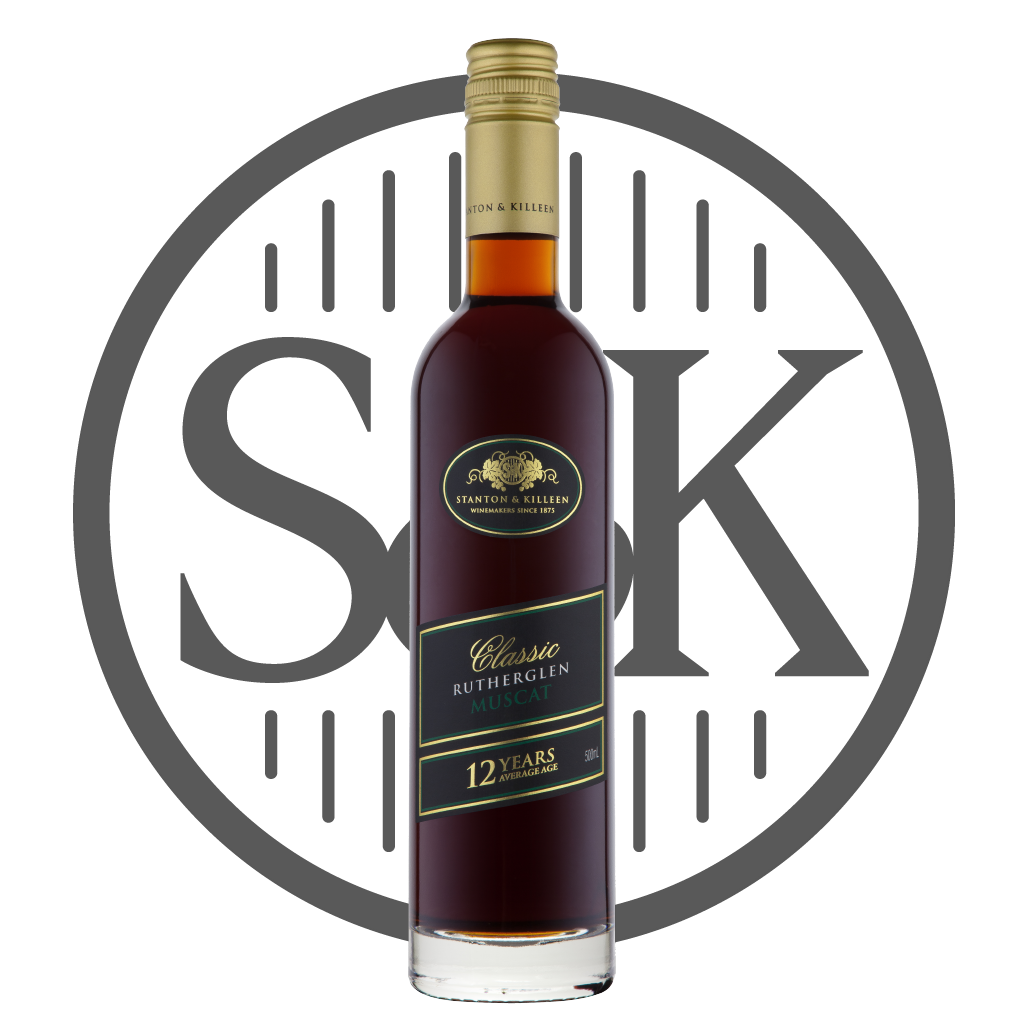
When blending our Classic Muscat, for example, the goal is twofold. First, to stay true to the S&K house style so that our Classic Muscat tastes the same whether you last opened a bottle five years ago or twenty. Second, to maintain an average age of around 12 years across the blend. That average does not mean every millilitre of Muscat in the bottle is 12 years old. It means the combined age of all the parcels used in the blend averages out to 12 years.
Young Muscat brings freshness, bright fruit and floral aromatics. Older Muscat brings complexity, acidity and depth. Getting the balance of both right, in a way that reflects the house style while meeting the classification standard, is the true art of Rutherglen winemaking. It is a skill that has been passed down through seven generations at Stanton & Killeen.
The Rutherglen Muscat Classification: A Guide to All Four Tiers
Muscat of Rutherglen is classified using a four-tier system that marks progression in richness, complexity, age and intensity of flavour. Each tier carries a protected trademark that can only be applied to wines meeting strict standards. Stanton & Killeen is one of only six Muscat houses in the world to produce all four tiers, each with its own distinctive character.
Rutherglen Muscat (Average Age: 3 to 5 Years)
The foundation style, and the place to start if you are new to Rutherglen Muscat. Fresh raisins, marmalade, rose petals and a touch of Turkish Delight characterise this tier, with bright fruit on the palate and a satisfying length of flavour. The rose petal and Turkish Delight characters in our Rutherglen Muscat are specific to the Stanton & Killeen site and soil. Serve slightly chilled as a dessert wine, drizzle over vanilla ice cream, or use as the base of a Muscat cocktail. Our NV Rutherglen Muscat is the perfect introduction to the style.
Classic Rutherglen Muscat (Average Age: 8 to 12 Years)
We call this the Goldilocks tier. It has the freshness and fruit of the entry level but considerably more richness and complexity from its extended time in oak. Turkish Delight, raisin, fruit cake and walnuts lead the way, and the beginnings of rancio, that distinctive nutty, aged character, start to show. It is the ideal middle ground for those who want depth without committing to the full intensity of Grand or Rare. Our NV Classic Muscat is one of our most decorated wines and a personal favourite of many on the S&K team.
Grand Rutherglen Muscat (Average Age: 12 to 19 Years)
Grand Muscat is where the style takes a significant step up in concentration, colour and complexity. Coffee, toffee, Christmas spice and molasses dominate, with a richness of texture that coats the palate and a finish that lingers long after the glass is empty. The rancio character is now prominent and the blending required to achieve this level of consistency is a genuine act of craft. Savour our NV Grand Muscat in a small glass alongside dark chocolate or aged blue cheese.
Rare Rutherglen Muscat (Average Age: 20 Years and Above)
The pinnacle of the classification and one of the most extraordinary wines made anywhere in the world. Rare Muscat displays deep colour, intense fruit, mature oak characters, a rich viscous texture and an extraordinary depth of mellowed complexity. Christmas spice, coffee bean and dark chocolate lead, but there is always something else underneath that resists easy description.
Rare is not a marketing word here. It is a legal designation applied only to wines meeting strict criteria of age, concentration and complexity. Our NV Rare Muscat includes parcels of material dating back to the 1970s, which means four generations of the Killeen family have contributed to this particular wine at some point in its history. Open it on an occasion that deserves it.
How to Serve Rutherglen Muscat
Rutherglen Muscat is one of the most versatile wines you can have in the house. Here are a few ways to enjoy it:
As a dessert wine: Serve the Rutherglen or Classic tier slightly chilled alongside cheese, blue cheese in particular, sticky date pudding, pecan tart, Christmas cake or dark chocolate. The wine’s natural acidity cuts through richness beautifully.
Over ice: A small pour of Rutherglen or Classic Muscat over a single large ice cube is one of the great simple pleasures. The dilution opens the aromatics and makes it surprisingly refreshing on a warm afternoon.
In cocktails: Rutherglen Muscat is a remarkable cocktail ingredient. Try it in a Muscat Spritz with soda and orange peel, or as the base for a sweet, stirred cocktail in place of vermouth. If you’ve visited our region, you may have tried the Muscat Gin Sour at Grace on Main Street, made with a local Muscat gin produced in collaboration with Scion Wines and Backwoods Distilling. It is a very good thing.
Neat at room temperature: For Grand and Rare, serve at room temperature in a small glass, ideally a dessert wine glass that concentrates the aromatics. This is the format that lets the full complexity of these wines come through. Sip slowly. There is a lot going on.
Seven Generations of Muscat at Stanton & Killeen
Muscat of Rutherglen is an Australian treasure. It is impossible to replicate because it is made from rare wine stocks that have been nurtured and passed down through multiple generations of winemakers, each leaving their own fingerprint on the blend before handing it on.
At Stanton & Killeen, those stocks carry more than a century of the Killeen family’s work. Seven generations of hands in the cellar, seven generations of decisions about which barrels to blend, which to hold back, and how much to give the angels. When you open a bottle of our Grand or Rare Muscat, you are drinking something that was begun long before any of us were here and will continue long after.
That is not something many wines can claim. And it is why Rutherglen is, proudly and without apology, the Muscat capital of the world.
Explore the full Stanton & Killeen Muscat range at stantonandkilleen.com.au.